Self-Guided Heritage Trail · Savannah, GA
Hallelujah and Holy Water | Early Church Trail
The Black Church | Take Me To The River

- 1 hour
- 8 stops
- Free
For an interactive map and audio narration, press Start this trail.
About This Trail
The Hallelujah and Holy Water Trail shows the church not as a place of passive faith, but of faith as strategy. The Black church became far more than a place of worship — it was a social institution, a mutual aid society, a school, a meeting hall, and, when necessary, a hiding place. It gave the enslaved and the newly free something the law refused to grant them: structure, dignity, and a claim to permanence. According to Robert Raboteau, "amid the profound isolation and heartbreak of chattel slavery, the secret gatherings of the 'Invisible Institution' served as a vital communal heart—a collective space where grief could be openly mourned, and hope could be kept alive." In Savannah, Black congregations made that heartbeat loud enough to carry people through slavery, into emancipation, and toward a future they had to build for themselves.
Georgia's 1750 slave code paid lip service to religious instruction for the enslaved; however, it came with an anxious asterisk — white Savannah was never truly comfortable with Black people gathering on their own, even to pray. White ministers preached obedience from the pulpit, using scripture as one more tool to keep order. But religion has always cut both ways. The same faith used to justify bondage became, in Black hands, a language of survival, community, and quiet resistance. Historian Joseph F. Waring once observed that Savannah's enslaved population never rose in open rebellion — and credited that calm, in part, to the strength of its Black religious leadership. But beneath that calm surface ran a current of unrest that never fully settled.
That spirit is stitched into everything along this trail — the brick sanctuaries raised after backbreaking labor was done for the day; the spirituals coded with escape routes, like the enslaved who followed the Drinking Gourd's stars toward freedom; the crawlspaces beneath sanctuary floors where fugitives waited in the dark; the pastors who rose from bondage to become power brokers, educators, and record-keepers of their own history. Some of these congregations trace their roots to the 1770s, making them among the oldest Black institutions in America — older than the nation's promise of freedom, and instrumental in finally making that promise real.
The Hallelujah and Holy Water Trail follows that thread through Savannah's squares and side streets: stories of worship as survival, architecture as declaration, and faith as the engine that carried a people from slavery through Reconstruction and into a future of their own making.
The Route
1First African Baptist Church
Location: 23 Montgomery Street
___
This sanctuary traces back to the 1770s and 1780s, when George Liele, an enslaved preacher, began evangelizing Black Georgians before the Revolutionary War. His influence shaped Andrew Bryan, himself enslaved, who organized Savannah's first Black Baptist congregation — formally dated to January 20, 1788. Gathering under laws designed to restrict Black assembly, education, and movement, these worshippers built one of America's earliest Black religious institutions from nothing.
The congregation grew into a family of churches — First African, First Bryan, Second African, Third (Ogeechee) African — sharing roots but later disputing which held the "true" claim to the founding legacy. This rivalry peaked during the 1888 centennial when the church was challenged to prove the claim of being the oldest Black congregation in the United States.
The towering figure of the antebellum years was Andrew C. Marshall, a formerly enslaved man who became a successful businessman, pastor, and moral authority across the region. Over 40+ years, he baptized roughly 3,800 people, performed over 1,000 marriages, and once paid to keep an enslaved family of twelve together rather than let them be sold apart.
In 1832, First African Baptist fractured over theology. Pastor Andrew C. Marshall allowed the controversial White minister, Alexander Campbell, to preach from the pulpit, embracing Campbell's "New Light" doctrine — a position that broke sharply with orthodox Baptist teaching. Savannah Baptist and the Sunbury Baptist Association reacted swiftly, expelling First African from the fellowship from 1832 to 1837. For those five years, the church existed outside recognition by Georgia's governing Baptist body; readmission wasn't granted until 1837, by which point membership had plummeted to 1810.
The controversy split the congregation itself. Deacon Adam Johnson argued the church could only survive by breaking from Marshall. When the two men put the choice to the members, over 1,800 sided with Marshall; just 155 stayed with Johnson. Johnson's minority remained at the original site on Bryan Street — the property Andrew Bryan had purchased decades earlier — continuing to worship there under what the Sunbury Association would later call the Third African Baptist Church.
Marshall's larger faction needed a new home. When Savannah Baptist, the White congregation, moved into a new brick building on Chippewa Square, Marshall purchased their vacant wooden church on Franklin Square for $1,500 — with help from sympathetic White allies. The congregation, most of them enslaved, raised $1,000 of that sum themselves: working for enslavers by day, hiring out their own labor by night, and donating what they earned to buy their church outright.
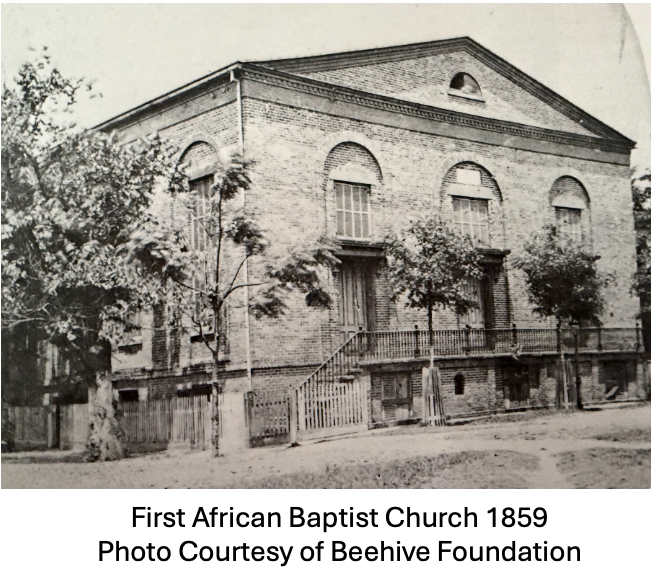
Marshall raised funds for a new church but died in 1856 before it was finished. Under Rev. William J. Campbell, the present brick sanctuary was completed in 1859, at a cost of just over ten thousand dollars — built by enslaved and free members after their day's forced labor ended. Women carried bricks in their aprons to the bricklayers. It's believed to be the first brick building in Georgia built and owned by African Americans, its walls four bricks thick.
Beneath the sanctuary floor lies a hidden crawlspace roughly four feet deep. Ventilation holes bored through the floor above — arranged, church tradition holds, in a pattern echoing the African BaKongo cosmogram — let air reach fugitives hidden below as they awaited passage north through Savannah's port and waterways on the Underground Railroad.
After emancipation in 1865, the church became a hub for Black schools, political organizing, and family life. Pastor Emanuel King Love, born enslaved in 1850, took the pulpit in 1885 and expanded the building — adding stained glass, a pipe organ, a 1,067-pound bronze bell, and electric lighting — while membership swelled to roughly 5,000. Today the church still holds its 1814 communion tray, hand-carved African-motif gallery pews, and the floor openings themselves: physical proof that this building was, at once, a public declaration that Black people could own, build, and endure — and a secret refuge for those still seeking freedom.
___
Sources:
Elmore, Charles J.,First Bryan 1788-2001. First Bryan Baptist Church, Savannah, Georgia. 2001. pp. 7-11
First African Baptist Church. “History.” Accessed August 24, 2026
Hoskins, Charles Lwanga. Yet With a Steady Beat: Autobiographies of Early Black Savannah. Savannah: Gullah Press, 2001, 43-45.
Love, Emanuel King. History of the First African Baptist Church, from Its Organization, January 20th, 1788, to July 1st, 1888*: Including the Centennial Celebration, Addresses, Sermons, etc. Savannah, GA
National Park Service.“First African Baptist Church.” National Register of Historic Places / Historic American Buildings Survey documentation. Accessed August 31, 2026
2First Bryan Baptist Church
Location: 575 West Bryan Street
___
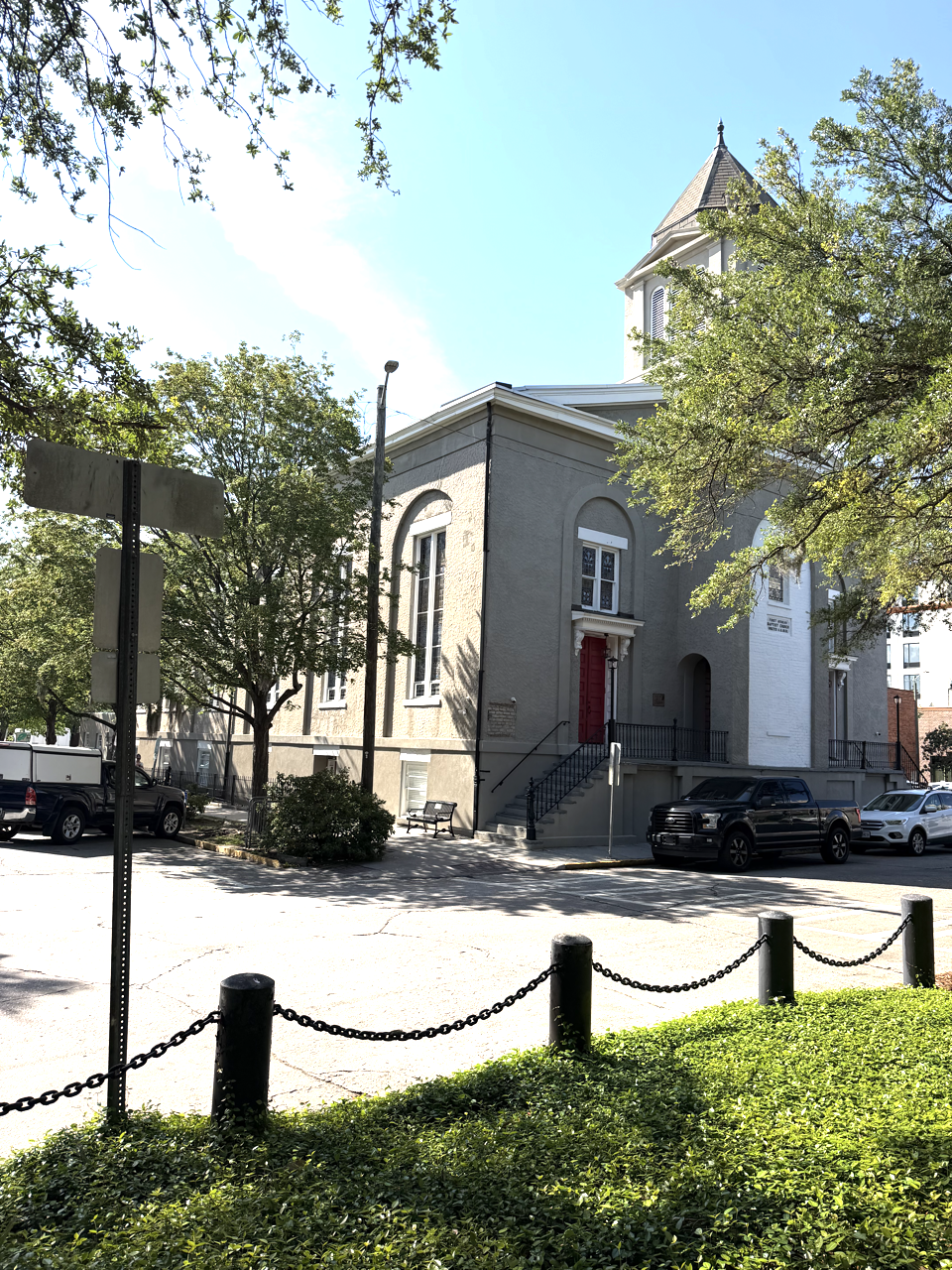
The story begins with George Liele, an enslaved Baptist preacher who became one of the earliest Black Baptist missionaries in Georgia, carrying the gospel to enslaved communities along the Savannah River and the plantations outside the city. At Jonathan Bryan's Brampton plantation, Liele preached to and baptized a small circle of believers — among them Andrew Bryan and his wife, Hannah. When Liele left for Jamaica to continue his ministry outside of the country, Andrew Bryan assumed leadership of the small Savannah fellowship he left behind.
What followed was not easy. The congregation worshipped first under the watch of a sympathetic plantation owner, then in a rough wooden meetinghouse in the Yamacraw section of the city. Historical accounts describe Andrew Bryan and his brother Sampson facing beatings and imprisonment for continuing to preach without White supervision — a reflection of just how threatening White Savannah found the idea of Black people gathering on their own, even to pray.
On January 20, 1788, the congregation reached the milestone both First Bryan and First African Baptist Church claim as their institutional birthday: visiting Baptist ministers baptized a group of new converts and formally ordained Andrew Bryan as pastor. It placed this Savannah congregation among the earliest formally organized Black Baptist churches in North America.
Freedom came next — purchased, not granted. After his enslaver's death, Andrew Bryan bought his own freedom, and on September 4, 1793, a deed transferred a lot on what is now Bryan Street to him, described in the record as belonging to "a free Black man" and ordained preacher. Church history and multiple independent sources put the purchase price at "thirty pounds sterling," roughly $150. That property is the ground First Bryan Baptist Church still stands on today, and it is widely cited — though difficult to verify with absolute national certainty — as one of the oldest parcels of real estate continuously owned by Black Americans in the United States.
Andrew Bryan led the congregation until his death in 1812. In 1826, a Sunday school for Black congregants was organized in connection with the church — an early and well-documented institution, even setting aside broader claims about being the very first of its kind in the country.
Then came rupture. In 1832, a doctrinal dispute over the teachings of a visiting White preacher, Reverend Alexander Campbell, split the congregation. He was advancing a "New Light" theology — antinomianism — which held that believers were not bound by the obligation of moral law. The larger group departed for Franklin Square and kept the name First African Baptist Church. A smaller group remained on the original Bryan Street property, later known for a time as the Third African Baptist Church, and eventually incorporated under the name First Bryan Baptist Church in the 1860s, honoring its founder. Both churches trace their roots to the same 1788 congregation — a shared origin that has fueled friendly historical debate between the two ever since.
Reconstruction brought the church back to the center of Savannah's story. Rev. Ulysses L. Houston, pastor of the Bryan Street congregation from 1861, was one of about twenty Black ministers who met with General William T. Sherman and Secretary of War Edwin Stanton in Savannah on January 12, 1865. — A conference that directly shaped Special Field Order No. 15, the promise of land for formerly enslaved families, issued days later. Houston went on to serve in the Georgia state legislature during Reconstruction, one of the Black lawmakers elected to office in 1868 before a wave of expulsions and violent backlash pushed many out of Georgia politics.
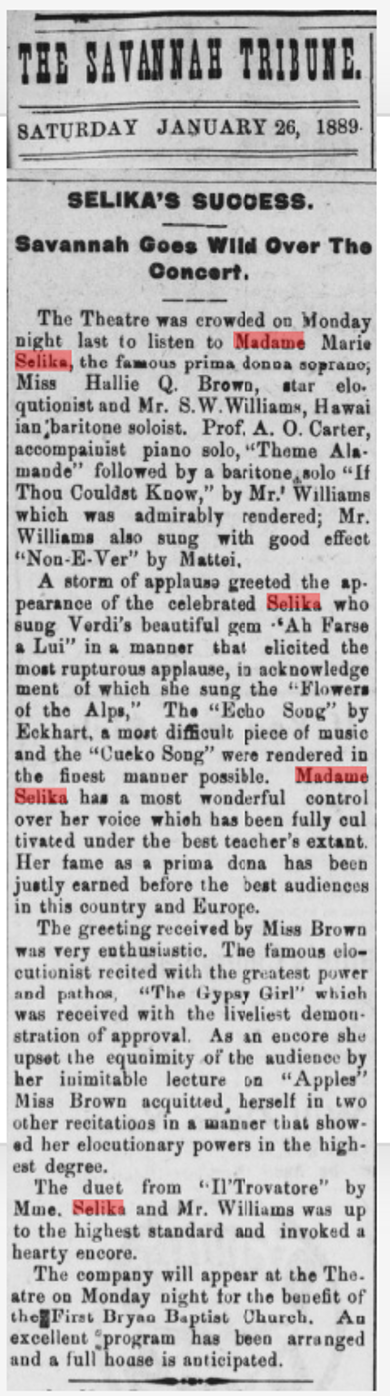
Black churches, and in this case First Bryan Baptist, despite all the social and political problems of Reconstruction, continued to add to the cultural environment of White and Black Savannah by bringing the famous Black operatic prima donna, Madame Marie Selika, to the Savannah Theater on January 28, 1889, under the auspices of the church to raise funds. Her performance featured A Farsi a Lui by Verdi; Flowers of the Alps; The Echo Song by Eckhart, and Cuckoo Song. She was accompanied on the piano by Professor A. O. Carter. Miss Hallie Brown, elocutionist, and Sampson Williams, baritone, sang on the program, which ended with a duet by Madame Selika and Williams from Il Travatore. Madame Selika was world famous and had sung in Europe and throughout America.
The sanctuary standing today traces to a building campaign begun in 1873, with the Grand Lodge of the Masons laying the cornerstone on October 13, 1873. The church was completed and dedicated by 1888 — a full century after Andrew Bryan's ordination. First Bryan is listed on the National Register of Historic Places, added in 1978, recognized for both its architecture and its unbroken religious significance on the same ground since the 1790s.
___
Sources:
Elmore, Charles J.,First Bryan 1788-2001. First Bryan Baptist Church, Savannah, Georgia. 2001
First Bryan Baptist Church. "Our History." Accessed August 31, 2026
Hoskins, Charles Lwanga. Yet With a Steady Beat: Autobiographies of Early Black Savannah. Savannah: Gullah Press, 2001, 40-47.
Madame Selika Concert,*Savannah Tribune, January 28, 1889
Morrison, Doreen. Slavery’s Heroes: George Liele and the Ethiopian Baptists of Jamaica, 1783–1865. Liele Books, 2015.
Woodson, Carter G. The History of the Negro Church. Washington, D.C.: Associated Publishers, 1921.
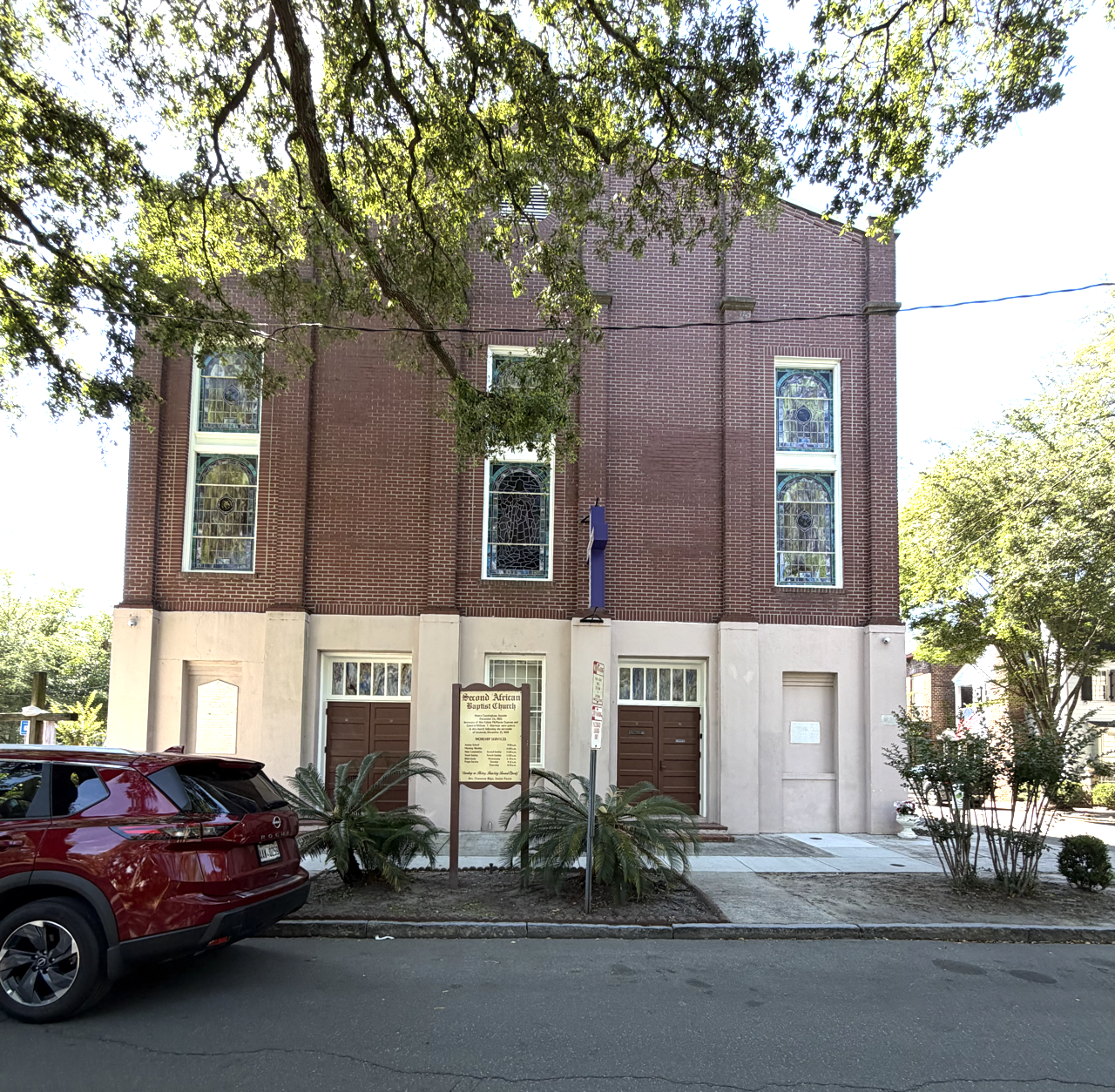
3Second African Baptist Church
Location:123 Houston Street
___
Second African Baptist Church was born of growth, not decline. By 1802, Savannah's original Black Baptist congregation — First African Baptist — had swelled beyond what one sanctuary could hold. On December 26, 1802, two hundred members were dismissed and joined with African Americans who had been worshipping separately within the White Savannah Baptist Church, forming a new congregation. The church was founded as The Second Colored Church, and in 1822, the word Colored was replaced with African.
Its first pastor was Rev. Henry Cunningham, a formerly enslaved man who would lead the church for the next thirty-one years, until 1833. His congregation looked like Savannah's Black urban working class: domestic servants, skilled mechanics, and free people of color living in the streets around the church. Many, inspired by their pastor's own path, went on to purchase their freedom. In 1823, the Sunbury Baptist Association formally renamed the congregation Second African Baptist Church, tying it permanently to the city's African American Baptist tradition.
The pastors who followed Cunningham trace the tangled, resilient family tree of Savannah's Black churches. Rev. Thomas Anderson, one of the congregation's original organizers, had himself been baptized by Andrew Bryan — the founding father of First African Baptist. In 1833, Anderson was called away to pastor a newly split congregation that would become First Bryan Baptist Church. Two years later, in 1835, he returned to Second African, serving until 1849 — a living thread connecting three of Savannah's oldest Black congregations to a single man.
The church's defining moment came at the close of the Civil War. Savannah fell to General William T. Sherman's forces in December 1864. In the fraught, hopeful weeks that followed, church tradition and a 1976 city historical marker hold that Sherman and Secretary of War Edwin M. Stanton sat down here with Savannah's Black ministers — including Second African's own Rev. John Cox — to ask a question no one had ever posed to freed people before: what do you actually need to build a life in freedom? Days later, Sherman issued Special Field Order No. 15, promising freedmen "forty acres and a mule" — one of the most consequential and contested documents of the Reconstruction era.
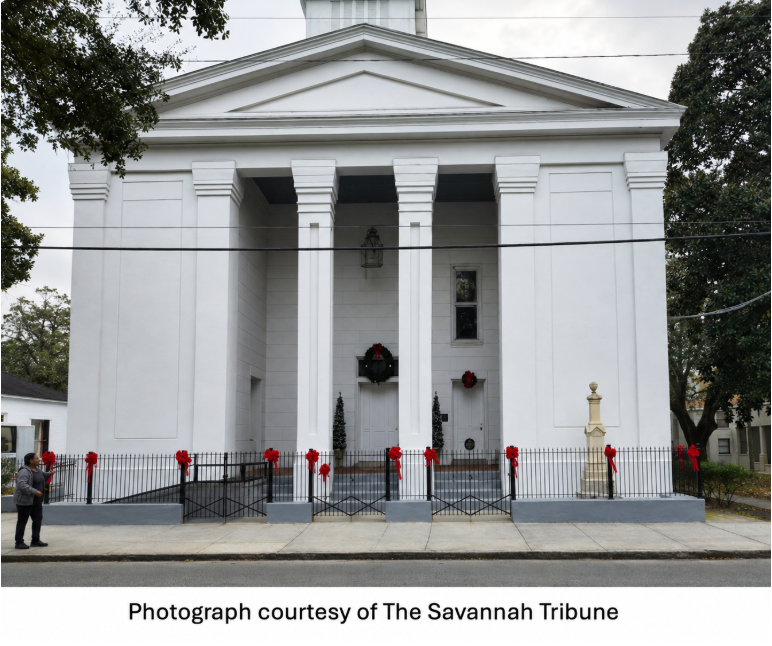
In the decades that followed, Second African Baptist became something like the cultural capital of Black Savannah. The church claims a string of firsts for the city: claiming the earliest Black congregation with an indoor baptismal pool, one of the first with a fully organized choir, and the first to hold a daily Vacation Bible School, launched in 1926 — the same year its current sanctuary was completed on Greene Square. It funded scholarships sending young Black women north to Spelman College in Atlanta, and it helped seed new congregations, including Beth Eden Baptist Church, extending its reach across generations. The sanctuary hosted concerts, lectures, and public meetings that reached well beyond Sunday worship.
That civic role reached its most famous moment in 1963, when Dr. Martin Luther King Jr. spoke at an NAACP meeting held in this sanctuary and previewed lines from what would become "I Have a Dream" — months before he delivered that speech to the nation from the steps of the Lincoln Memorial.
The church was added to the National Register of Historic Places in 1966 as part of the Savannah Historic District, and the congregation still worships in the 1926 building today — an unbroken line running from twenty-six founding members in 1802 to a living church in the twenty-first century. A short walk up Houston Street from Crawford Square, Second African Baptist stands as proof that Savannah's Black churches were never just places of worship — they were where freedom was organized, taught, funded, and, in this case, first put into words that would echo across a century.
___
Sources:
Find a Grave. "Rev Henry Cunningham (1759–1832)." Memorial #82443094. Created December 27, 2011
Hoskins, Charles Lwanga. Yet With a Steady Beat: Autobiographies of Early Black Savannah. Savannah: Gullah Press, 2001, 47-52.
Johnson, Whittington B. Black Savannah, 1788–1864. Fayetteville: University of Arkansas Press, 1996.
Lumpkin-White, Arva. Photograph credit

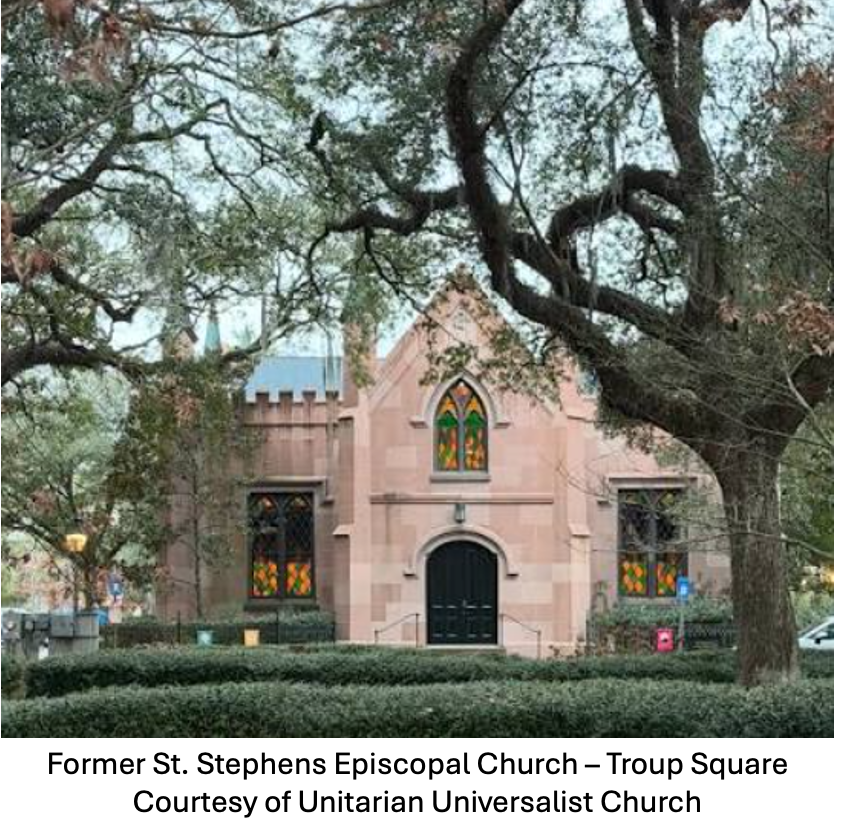
4St. Stephen’s Episcopal Church (Now home to Unitarian Universalist Church)
Location: 321 Habersham Street
___
Born above a bakery.
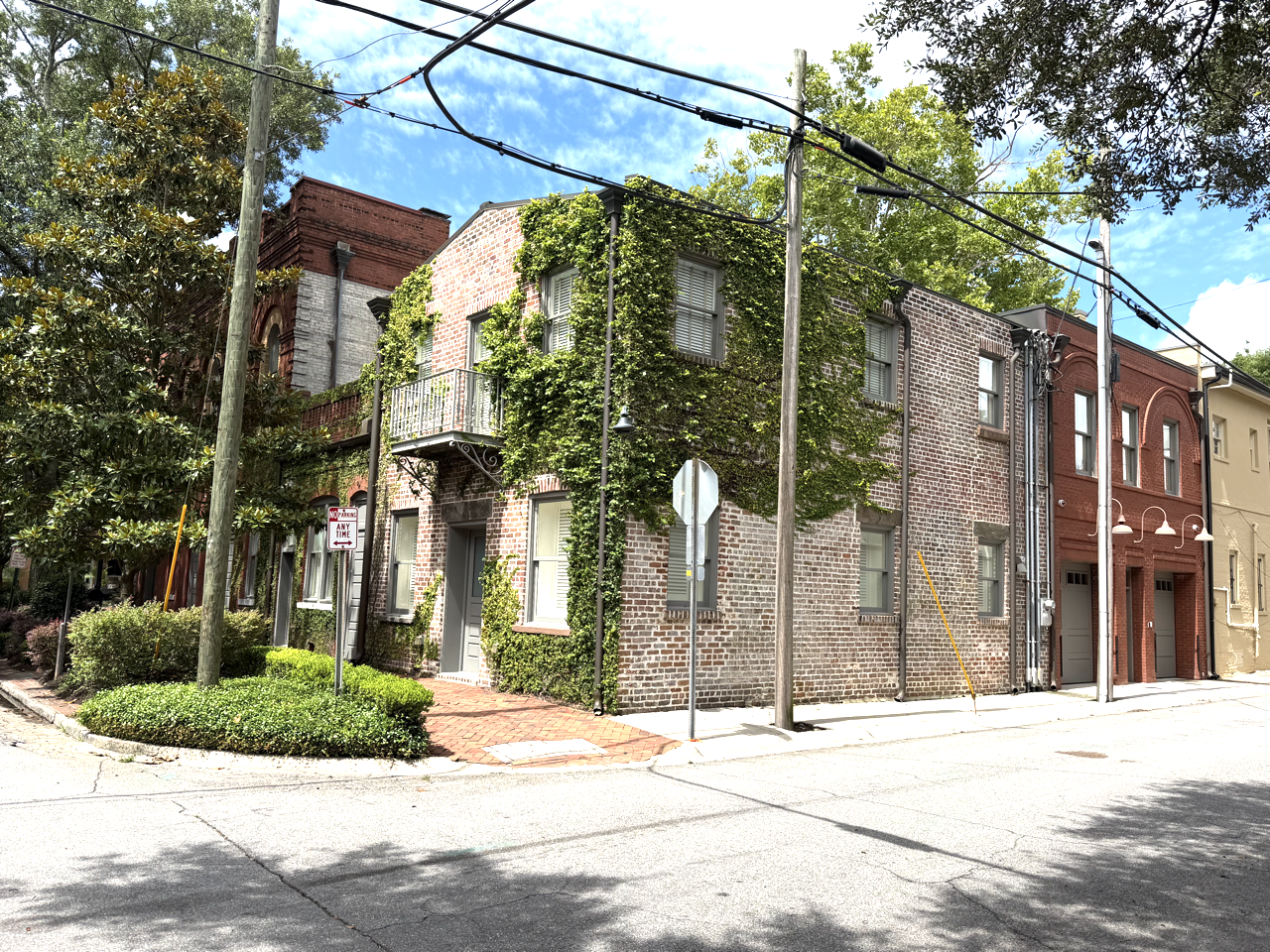
In the winter of 1855, William J. Claghorn and a small circle of Savannah's free Black residents organized a congregation. Claghorn, born in Savannah around 1822, was a master baker and a caterer of genuine local renown — the white press of the day praised the "fancy confectionery" and "ornamental icing" at his catered events, work he and his family produced themselves. By 1850, he owned $4,000 in real estate and $2,000 in personal property, a striking measure of independence for a free Black tradesman in antebellum Savannah. He and his wife, Cornelia, a seamstress, had obtained their freedom sometime before 1856.
Claghorn offered the workshop above his bakery at Liberty Street and Habersham, on the back side at Perry Lane, as a meeting space. The Rev. Sherod Kennerly, sent to organize the mission, later described the space in his own words: a large workshop above what he called the finest bakery in the city, owned by a man he considered among the city's most respected. The new congregation was established specifically for the exclusive use of people of color — Savannah's first urban Episcopal mission built expressly for free Black worshippers, following the Diocese's 1852 decision to close its rural mission to enslaved people on the Savannah River and redirect that ministry into the city.
Church records place the Claghorn family as members living on Bryan Street by 1868, still active in the congregation more than a decade after they'd offered up their own workshop to start it.
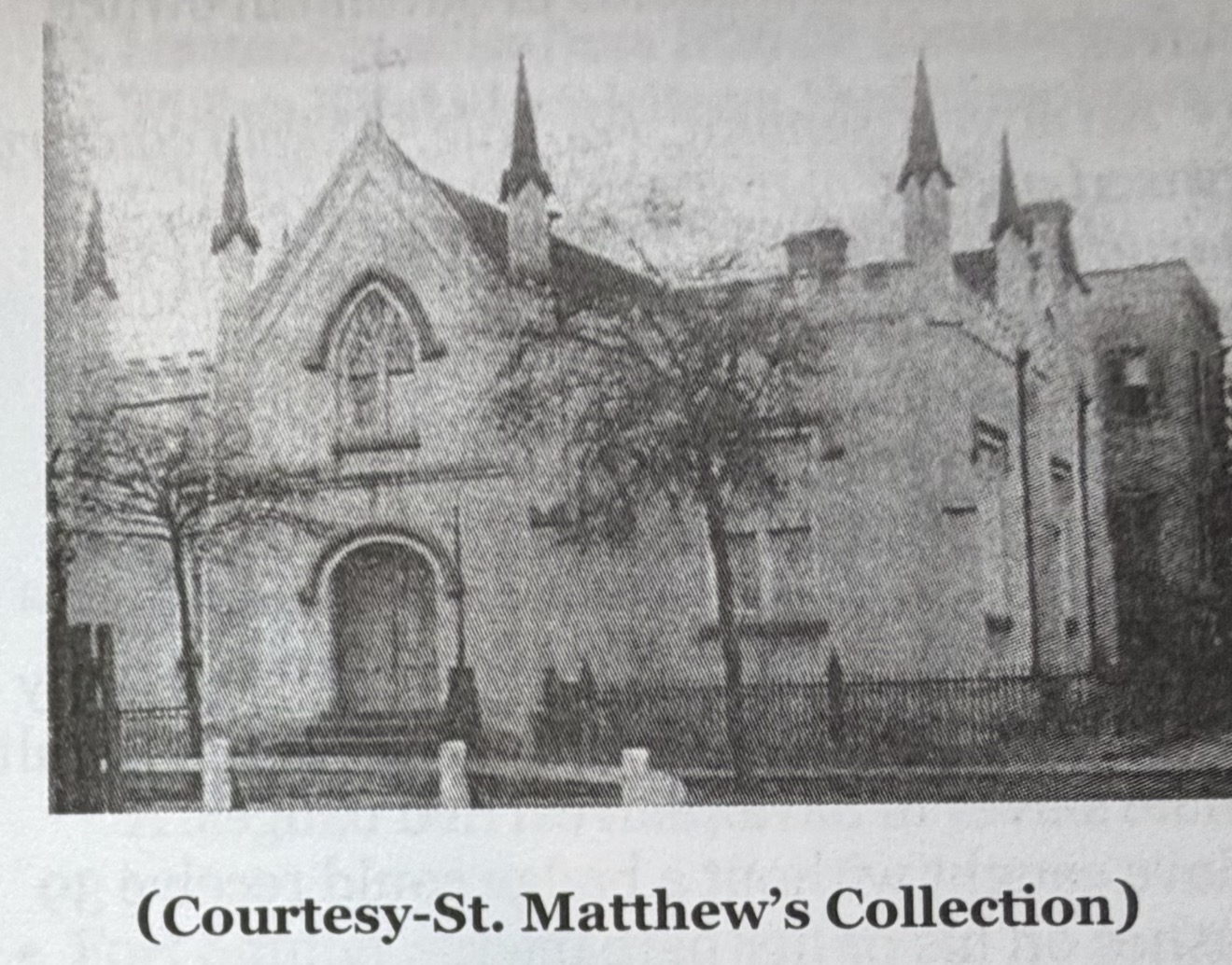
By 1860, the growing congregation needed real room to worship. They purchased an unused building originally designed by architect John Norris for Savannah's Unitarian congregation and moved it — reportedly rolled on logs — from its original site to what is now Troup Square. According to community historian Eleanor (Nellie) Pollard, it was the members of St. Stephen's themselves who did the physical work of converting the building for Episcopal worship, adapting a structure built for someone else's liturgy into a home fit for their own.
The building carried one more claim to fame: its organist during the Unitarian years was James Pierpont, who composed "Jingle Bells" while playing there.
If Claghorn built the congregation, James Porter carried it through its most consequential years. Born free in Charleston in 1826, Porter was a trained musician who led the church's choir to real acclaim — when Bishop Stephen Elliott visited for confirmation in 1857, he singled out the choir's musical skill as a credit not just to the singers themselves, but, in the language of the time, to their race as a whole.
Porter became the first African American senior warden in the Diocese of Georgia and led the congregation through the Civil War. In January 1865, he was one of twenty Black leaders in Savannah who sat down with Secretary of War Edwin Stanton and General William T. Sherman — the meeting that helped shape Special Field Order No. 15. Porter's own words to the church convention, delivered around this period, describe a congregation working through real hardship: services held twice every Sabbath, special observances at Christmas and through Lent, and a standing his church had only recently begun to earn in the eyes of Savannah's Black community. A Savannah Daily Herald advertisement from 1865, listing the city's Black congregations, placed St. Stephen's alongside First African Baptist and other Black congregations— with Porter as lay reader in charge. The ad still lists the church on Calhoun Square.
The congregation's postwar years were a mix of struggle and self-reliance. In 1865, members held a fair to raise money and redeem their chapel from debt. Around the same period, the church's vestry couldn't even muster a quorum for its own annual elections — a small, human detail of an institution still finding its footing. Out of that same congregation came the Savannah Mutual Benevolent Association, organized by St. Stephen's members to care for the city's sick and destitute Black residents — mutual aid built directly out of the church's own membership.
In 1871, Savannah's Board of Education took over St. Stephen's own private school and reopened it as the city's first public school for Black students, housed in the church's unused rectory on East Harris Street. Months later, a fire — one that contemporaries described as suspicious — damaged the building, and the school relocated to the Scarborough House on what is now Martin Luther King, Junior Boulevard. (Currently the Ships of the Sea Museum). The building also suffered extensive water damage in an 1887 storm. The late Henry L. Giles, who had served the church diligently as a past senior warden, was a carpenter and builder by trade and usually managed major parish repairs; however, the congregation was fortunate to welcome R. J. Artson as a local builder and carpenter to help rebuild the damaged church. The congregation operates today as St. Matthew's Episcopal Church at 1401 Martin Luther King Junior Boulevard. For a brief but real moment, this congregation's own schoolhouse became the seed of public Black education in Savannah.
___
Sources:
Hoskins, Charles Lwanga. Yet With a Steady Beat: Biographies of Early Black Savannah. Savannah: Gullah Press, 2001, 55-61.
Lumpkin-White, Arva. Photograph credit: others as noted.

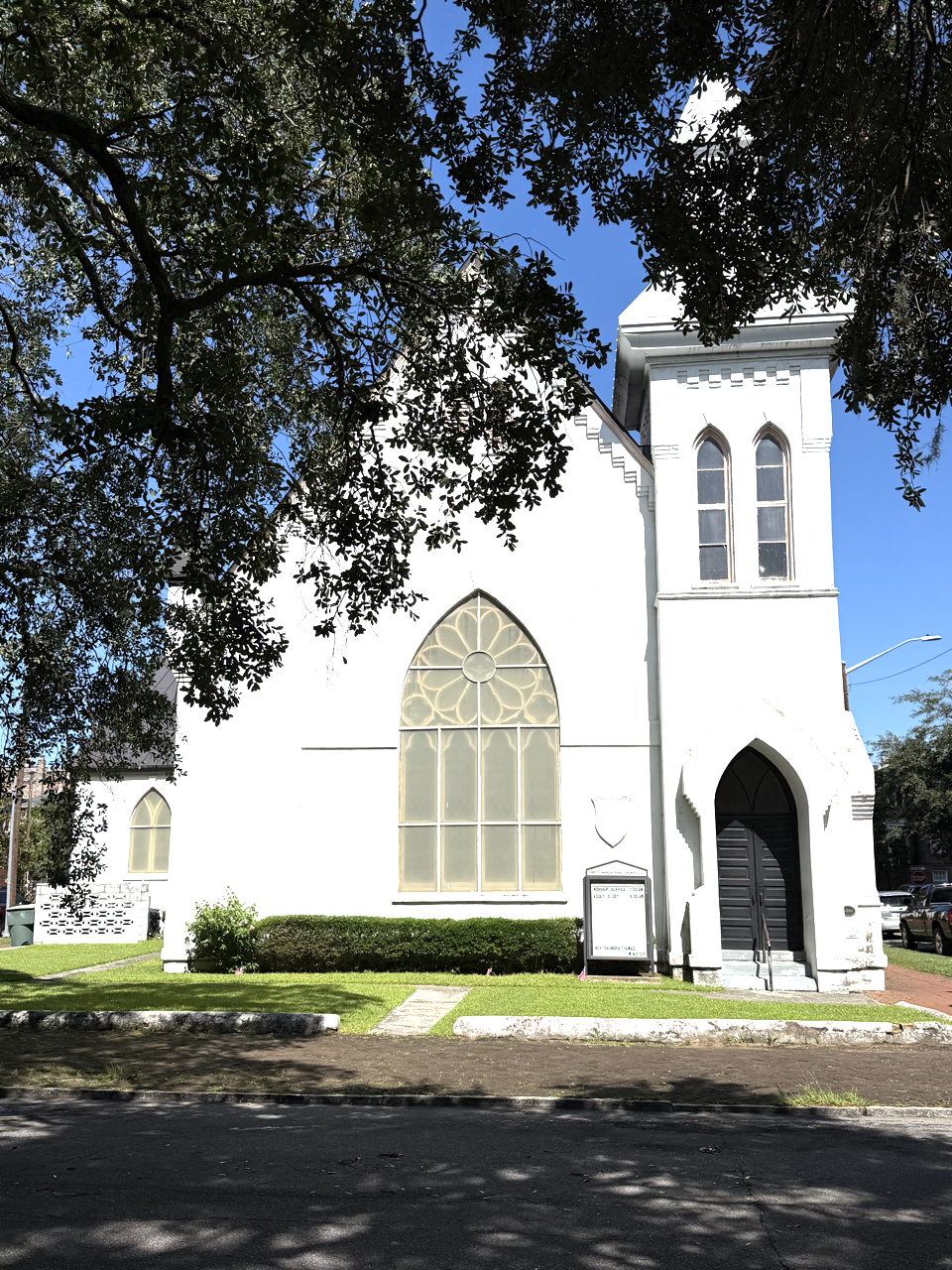
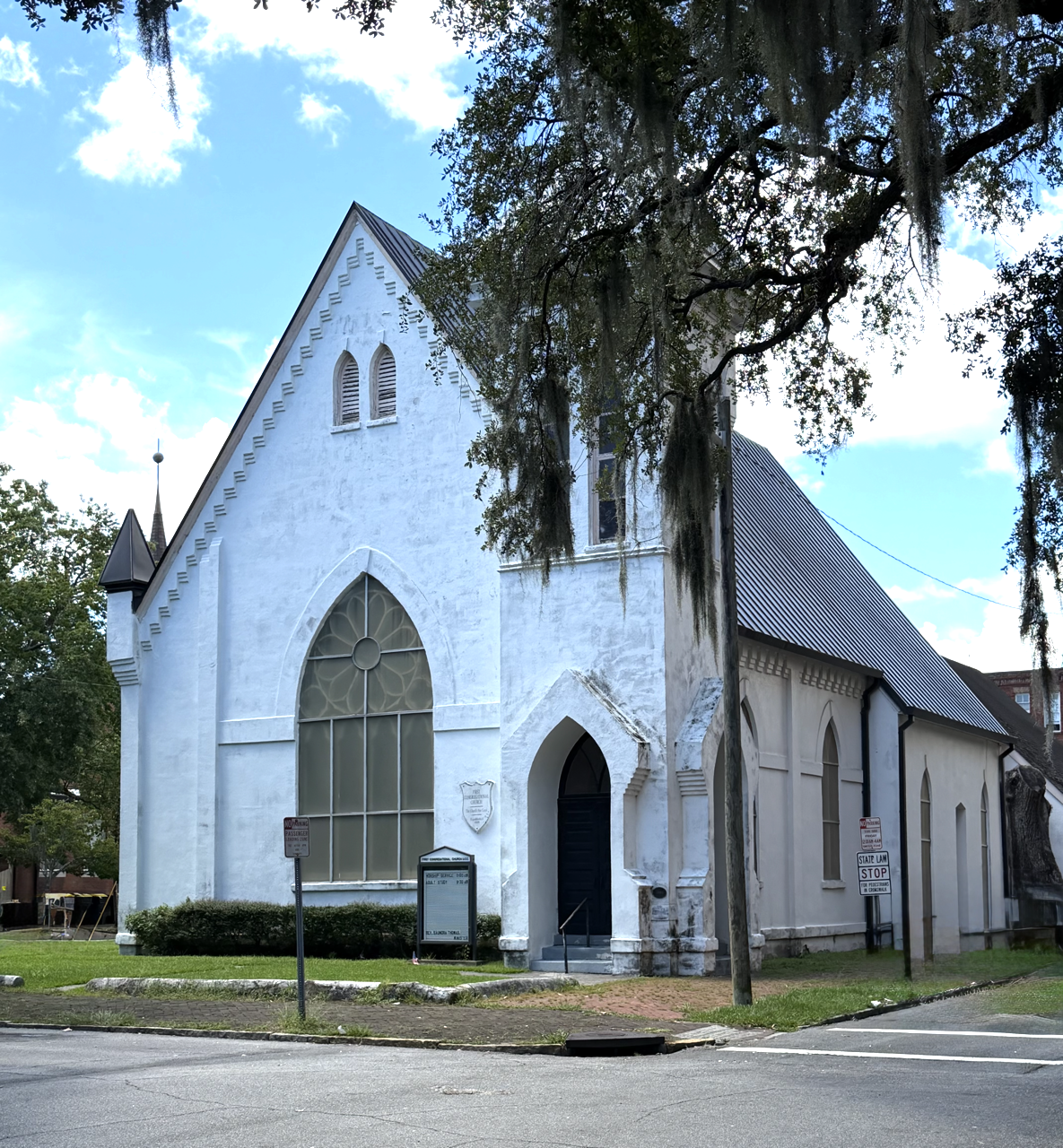
5First Congregational Church
Location: 421 Habersham Street
Where First Bryan and First African trace their roots into the eighteenth century, First Congregational tells a different kind of Savannah story — one written in the first years of freedom itself.
To understand why this church matters, it helps to understand what came before it. Georgia law had long prohibited teaching enslaved people to read, and Savannah reinforced that ban locally in 1817 and 1839, with the state adding further restrictions in 1829. Those laws didn't stop Black literacy — they just pushed it underground, into private homes, informal Sabbath schools, and clandestine networks sustained by enormous personal risk. Savannah's Black churches, especially First African Baptist, had long served as more than places of worship: they were schools, meeting halls, and centers of community life built and run by African Americans themselves, decades before anyone called it "Reconstruction education." One of the most striking figures from this hidden tradition is Susie King Taylor, born enslaved in Savannah in 1848 and secretly taught to read as a child. During the Civil War, Taylor went on to teach formerly enslaved people attached to Union forces and later established her own schools — a living bridge between the underground literacy of slavery and the public schools that would soon follow.
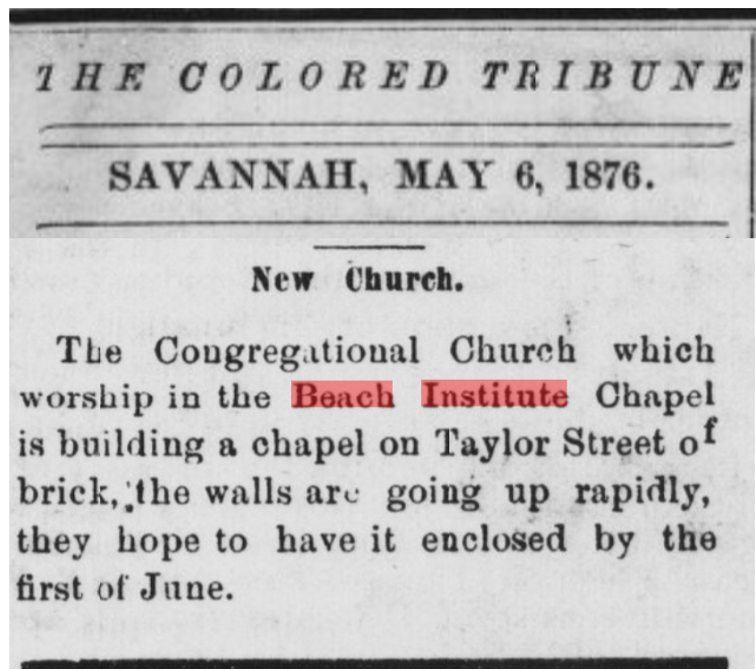
That public turn began almost immediately after emancipation. In 1865, Savannah's own Savannah Education Association — organized by the Black community itself — helped launch the Oglethorpe Colored Free School, which would grow into the Beach Institute. The school soon drew the support of the American Missionary Association (AMA), a Northern reform organization founded in 1846 that united Congregationalists, Presbyterians, Methodists, and other Protestant abolitionists committed to Black education. By 1867, the Beach Institute had a permanent home at 502 East Harris Street, built with financial help from New York publisher and philanthropist Alfred Ely Beach — though it's worth emphasizing that the building's success depended on Black demand, labor, leadership, and sustained community investment, not simply Northern philanthropy handed down from outside.
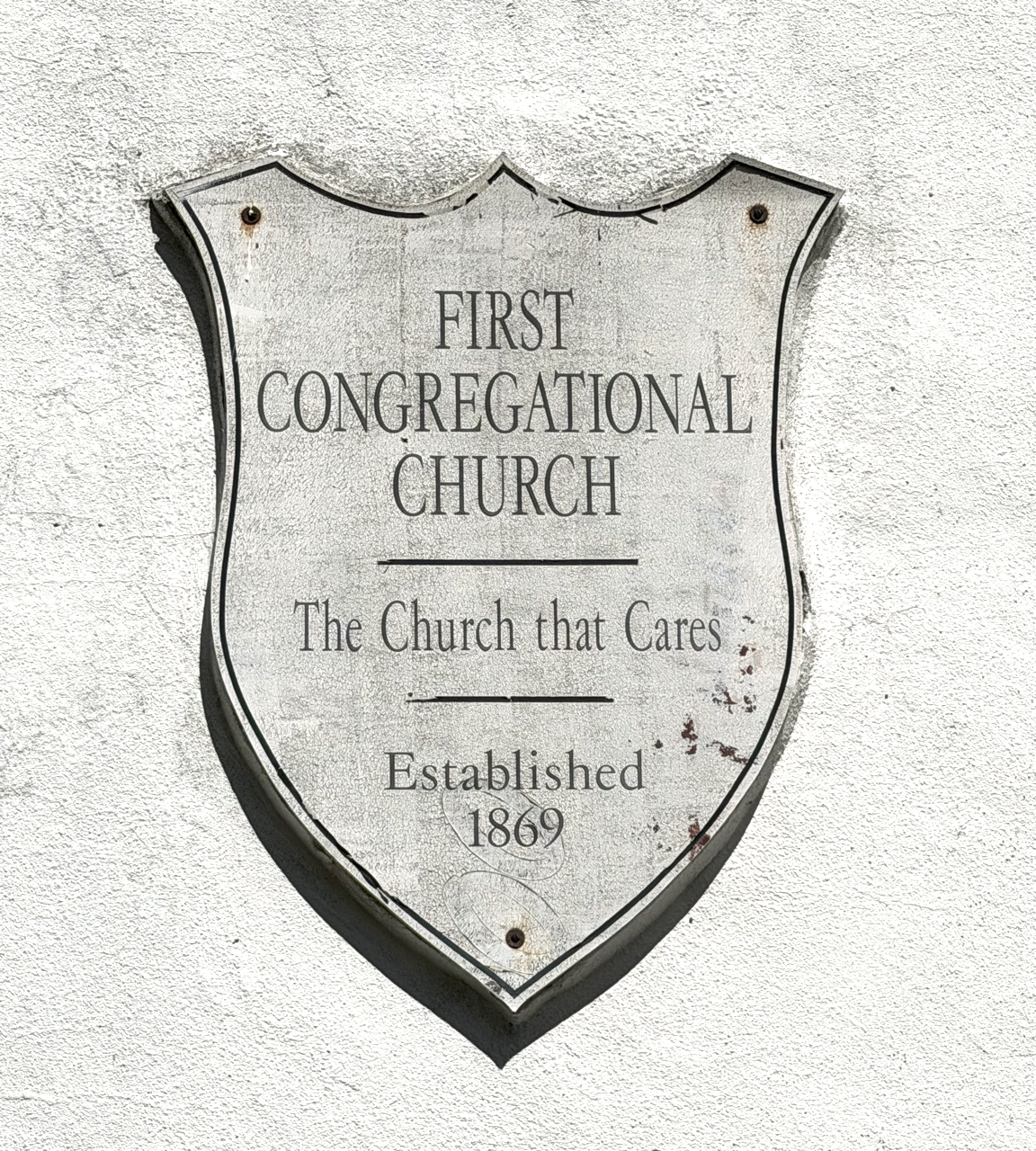
First Congregational Church was born directly from that environment. It was organized in April 1869 — just four years after the end of slavery — by thirteen founding members together with Rev. Robert L. Carter. Its earliest congregation was a genuine mix of white AMA missionary teachers and African American students and families connected to the Beach Institute, and before it had a building of its own, the church met inside the school itself. Church and classroom shared the same walls, the same mission, and often the very same people — literacy, faith, and citizenship treated as parts of a single project of freedom.
The congregation eventually secured land at Taylor and Habersham Streets, and the Gothic-style sanctuary standing today was completed in 1895 — a solid, purpose-built home for a congregation that had spent its first quarter-century meeting wherever Reconstruction's new institutions could find room.
It's worth being precise about what this church represents, because the honest version is more powerful than any simplified myth. First Congregational didn't teach enslaved people to read — it didn't exist yet. Its true significance lies in what it did next: it took the clandestine literacy tradition Black Savannahians had practiced in secret for generations and helped transform it into something public, funded, and permanent. Historians of Reconstruction-era Black education, including James D. Anderson and Ronald E. Butchart, emphasize that this transformation wasn't simply a gift from Northern missionaries — freedpeople themselves demanded schools, selected their own teachers, and raised their own money, shaping these new institutions to serve their own vision of freedom.
The Beach Institute itself operated for roughly half a century before newer public schools and Georgia State Industrial College — later Savannah State University — gradually took over its role. But its legacy never disappeared. It lives on in the name of Beach High School, in the generations of Black teachers and professionals who passed through its doors, and today, in the Beach Institute African-American Cultural Center, which preserves and interprets this history on the very site where it began. First Congregational Church, standing a few blocks away, remains the clearest living link to that story — a congregation literally built inside a schoolhouse, at the exact moment freedom became something Black Savannahians could build in daylight.
___
Sources:
Gadsen, Robert A. Brief History of the First Congregational Church, United Church of Christ, Savannah, GA, April 1869–April 1969. Georgia Historical Society (1969)
Hoskins, Charles Lwanga. Yet With a Steady Beat: Autobiographies of Early Black Savannah. Savannah: Gullah Press, 2001, 73-75.
Lumpkin-White, Arva. Photograph credit.
[The Colored Tribune (Savannah, GA). "Galileo." May 6, 1876. Georgia Historic Newspapers, GALILEO]
(https://gahistoricnewspapers.galileo.usg.edu/lccn/sn82016225/1876-05-06/ed-1/seq-3/print/image594x817from0,0to_4126,5672/)

6St. Benedict the Moor Catholic Church
Location: 556 East Gordon Street
St. Benedict the Moor is the oldest Black Catholic parish in Georgia — founded at a moment when the Catholic Church, like the city's Protestant denominations, was working out how to minister to a newly free Black population.
On May 13, 1874, two Benedictine priests, Rev. Bergier and Rev. Wissel, arrived in Savannah at Bishop William Gross's invitation to educate Black Catholics. Many of them were formerly enslaved. They built and dedicated a small frame church at East Broad and Harris Streets in just two weeks. Tragedy followed quickly: a yellow fever epidemic in 1876 killed Father Bergier and forced the Benedictines to withdraw temporarily.
The bishop purchased the present site in 1888, and on July 14, 1889, the cornerstone was laid for a new Gothic-style church seating 400, with a basement of five rooms set aside for a school. Remarkably, the entire cost — $10,655, including the lot — came from two bishops and outside donors; not one cent was raised locally. The dedication drew a crowd nearly evenly split between White and Black Savannahians, honoring a church built to serve the city's roughly 500 Black Catholics. Sister Matilda Beasley, two fellow sisters, and twenty orphans, ages two to sixteen, marched in with silk banners — the seed of what would become a dedicated orphanage for Black girls.
One striking detail: the 1889 church was originally dedicated to Saint Benedict the Abbot, founder of the Benedictine order. Later, at the congregation's own request, Bishop Benjamin Keiley rededicated it to Saint Benedict the Moor, the Afro-Sicilian saint — the community claiming a patron who reflected their own identity.
The Benedictines staffed the parish until 1907, when the Society of African Missions took over under Rev. Ignatius Lissner and Rev. Gustave Obrecht, and St. Benedict's became formally known as the "Mother Church" of Black Catholics in Georgia. The 1889 building gave way in 1949 to the current red-brick sanctuary, designed by architect Cletus W. Bergen.
Next door at 439 East Broad, a 1908 building served as an orphanage, school, and convent for the Missionary Franciscan Sisters, who staffed St. Benedict's day school until it closed in 1969 amid integration. Its most famous alumnus, Justice Clarence Thomas, once served there as an altar boy; Savannah College of Art and Design (SCAD) later restored the building as the "Clarence Thomas Center," though its sign was removed in 2022.
That school and orphanage trace back to Mother Matilda Beasley, a formerly enslaved woman who secretly taught Black children to read before the Civil War, trained as a Franciscan nun in England, and returned to Savannah in 1887 to found the St. Francis Home for Colored Orphans and, in 1889, Georgia's first community of Black nuns. Her marker stands at Sacred Heart Catholic Church, 1707 Bull Street — a natural companion stop on this trail.
The Diocese of Savannah resumed direct care of the parish in 1968. More than 150 years after two priests built a church in two weeks, St. Benedict the Moor still stands on East Broad Street, a living parish rather than a monument.
___
*Sources:**
BlackPast.org. "Mother Mathilda Beasley (1832–1903)." Accessed August 31, 2026
DeLorme, Rita H. "Mother Matilda Beasley Recalled",The Southern Cross, January 28, 1999
Georgia Historical Society. "Mother Mathilda Beasley, O.S.F.: Georgia's First Black Nun." Historical marker. Accessed August 31, 2026
Georgia Historical Society. "St. Benedict the Moor Catholic Church: Mother Church of Black Catholics in Georgia." Historical marker, erected 2008. Accessed August 31, 2026
Hoskins, Charles Lwanga.Yet with a Steady Beat: Biographies of Early Black Savannah. Savannah: Gullah Press, 2001, 61–65.

7Beth Eden Baptist Church
Location: — 302 East Gordon Street
___
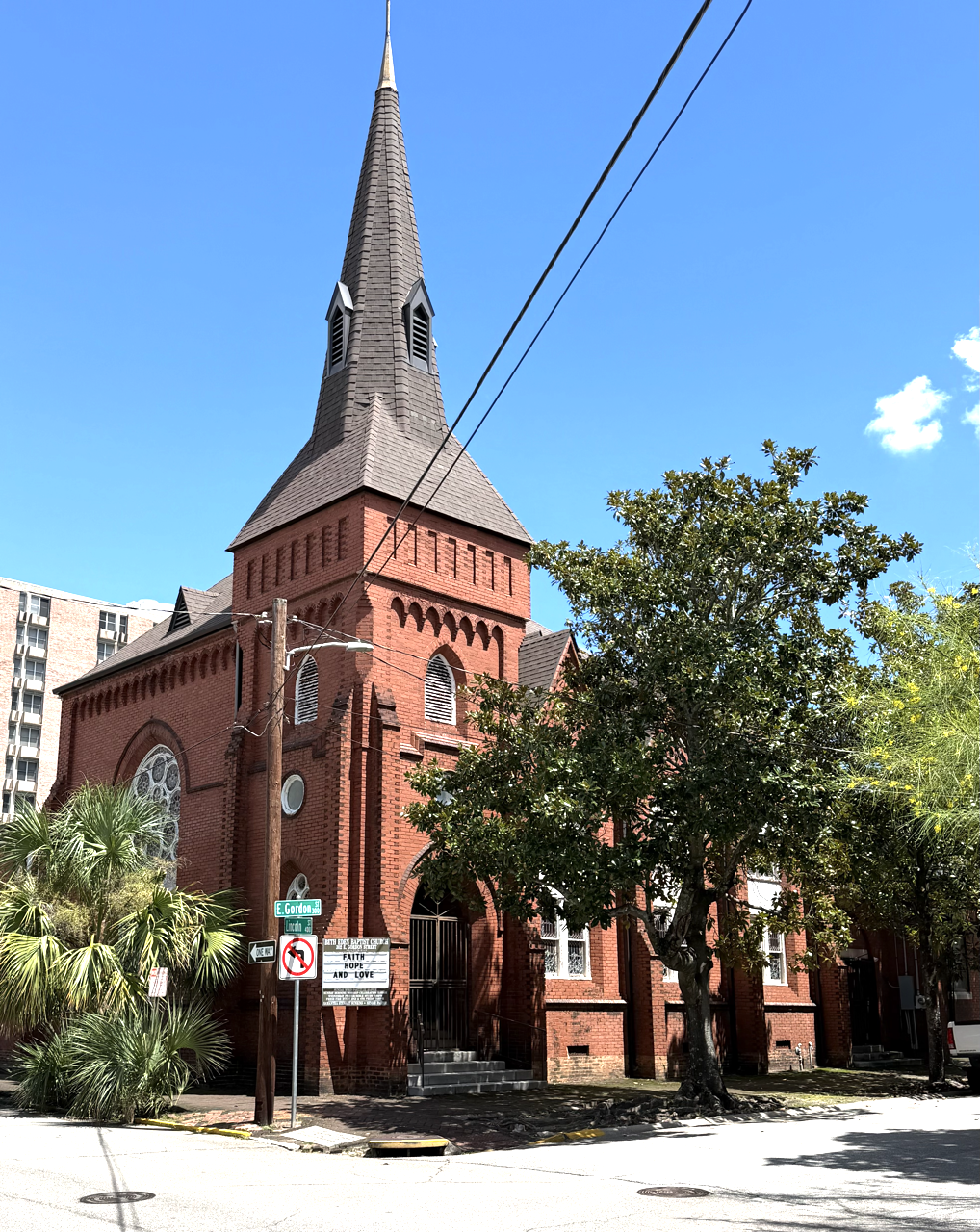
Beth Eden carries a double lineage rare even among Savannah's historic Black churches — a "granddaughter" of First African Baptist Church, and a direct daughter of Second African Baptist. Second African had itself broken away from First African back in 1802; nearly ninety years later, in the late 1880s, history repeated itself. A leadership dispute led to the removal of Second African's pastor, Rev. Alexander Ellis, and a portion of the congregation chose to follow him rather than stay behind. Sources differ slightly on the exact founding date — some point to 1889, while the church's own tradition and later directory records cite December 28, 1890 as the date of formal organization. Either way, a new congregation was born from rupture, determined to build something permanent of its own.
Ellis didn't just found the church — he built its institutional backbone. A turn-of-the-century Savannah city directory lists Beth Eden at 302 East Gordon Street with Ellis as both pastor and Sunday-school superintendent, presiding over a congregation of roughly 520 members and 250 Sunday-school pupils — a substantial institution for a breakaway body not yet a decade old.
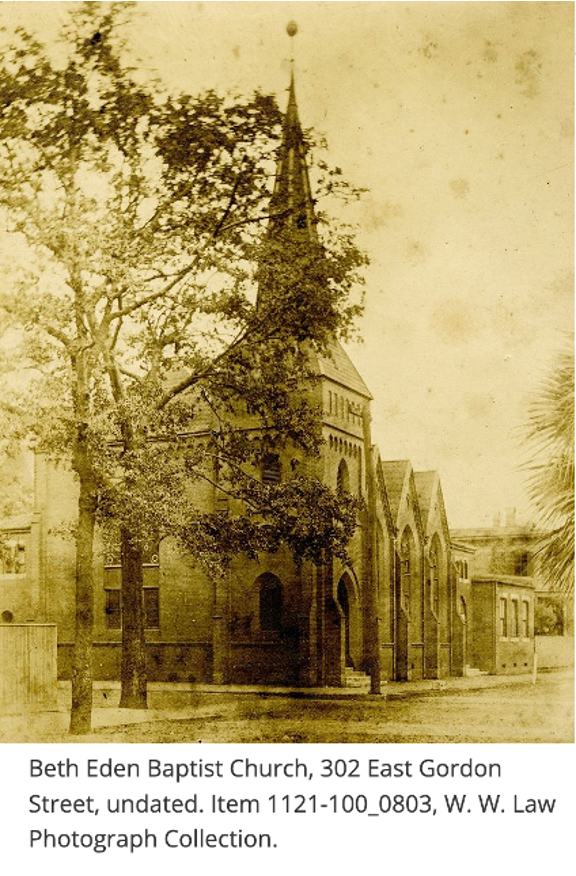
That growth demanded a real home. Beth Eden's sanctuary, designed by German-born Savannah architect Henry C. Urban, is generally dated to 1893, though the congregation didn't actually occupy the building's lecture room until March 1898, with a full dedication following that September. The finished land and building cost 16,312.75 — a striking sum for a Black congregation only a generation removed from slavery, and a public statement of permanence and self-sufficiency. The dedication was a major citywide event: morning organ music, choral anthems, scripture readings, a sermon by Rev. M. W. Gilbert, a formal dedication led by Rev. Alexander Harris, and an evening sermon by Rev. E. M. Brawley. The Savannah Tribune's coverage praised Ellis for the "great energy" behind the project and explicitly invited the wider public to witness it.
Architecturally, Beth Eden stands apart from Savannah's usual church pattern. Most of the city's historic sanctuaries face directly onto one of its famous squares; Beth Eden instead occupies the rear of an urban trust lot near Whitefield Square, addressing the street from a compact footprint. Architectural historians classify its style as Gothic Revival — more specifically, Lombard Gothic — featuring red brick masonry, a stout corner tower, a broach spire, a corner entrance, pointed-arch windows and interior arches, and a gallery held aloft by slender iron columns. Despite its modest lot, the interior opens into a genuinely monumental worship space.
The congregation's commitment to permanence didn't stop at the building's dedication. By the 1910s, Beth Eden was carrying roughly $12,000 in debt on the property. Under Rev. N. M. Clarke, pastor by 1915, the church mounted a successful mortgage-burning campaign, eliminating that debt by 1917 — a sustained, congregation-wide effort that a Savannah Tribune article of the time held up as proof of the church's organizational strength, active clubs, and citywide reputation.
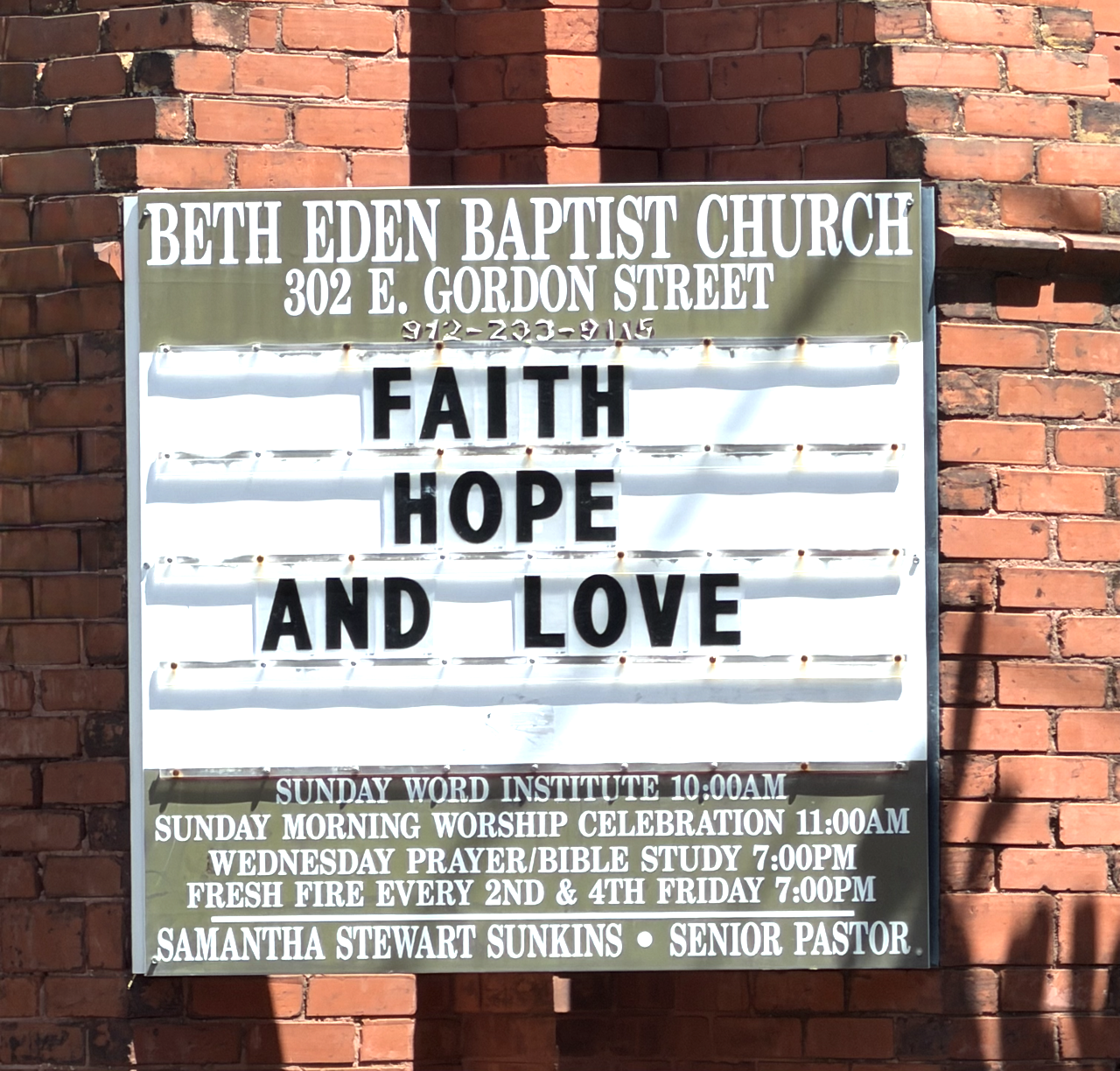
Step inside today, and Beth Eden still holds original stained-glass windows, historic combination gas-and-electric light fixtures, and a striking frieze above the choir loft depicting the Last Supper in a distinctive local style — work associated with Savannah folk artist William Pleasant, whose surviving art is rarely found elsewhere in the city. In recent years, the congregation made history again by naming Rev. Samantha Stewart Sunkins — who grew up in these very pews, experienced her own conversion here as a teenager, and later returned after decades away — as Beth Eden's first female pastor.
From a painful split to a debt-free sanctuary to a homecoming in the pulpit, Beth Eden's story is Savannah's Black church tradition in miniature: rupture met with resolve, and resolve built into something that has lasted well over a century.
___
Sources:
Beth Eden Baptist Church. “Our History.” Accessed August 31, 2026
City of Savannah. “African American Churches of Savannah.” W.W. Law Collection. Courtesy of the Municipal Archives.
Hoskins, Charles Lwanga. Yet With a Steady Beat: Autobiographies of Early Black Savannah. Savannah: Gullah Press, 2001, 47-52.
Lumpkin-White, Arva. Photograph credit: others as noted.
8Saint Philip African Methodist Episcopal Church
Location: 613 Martin Luther King Jr. Boulevard
___
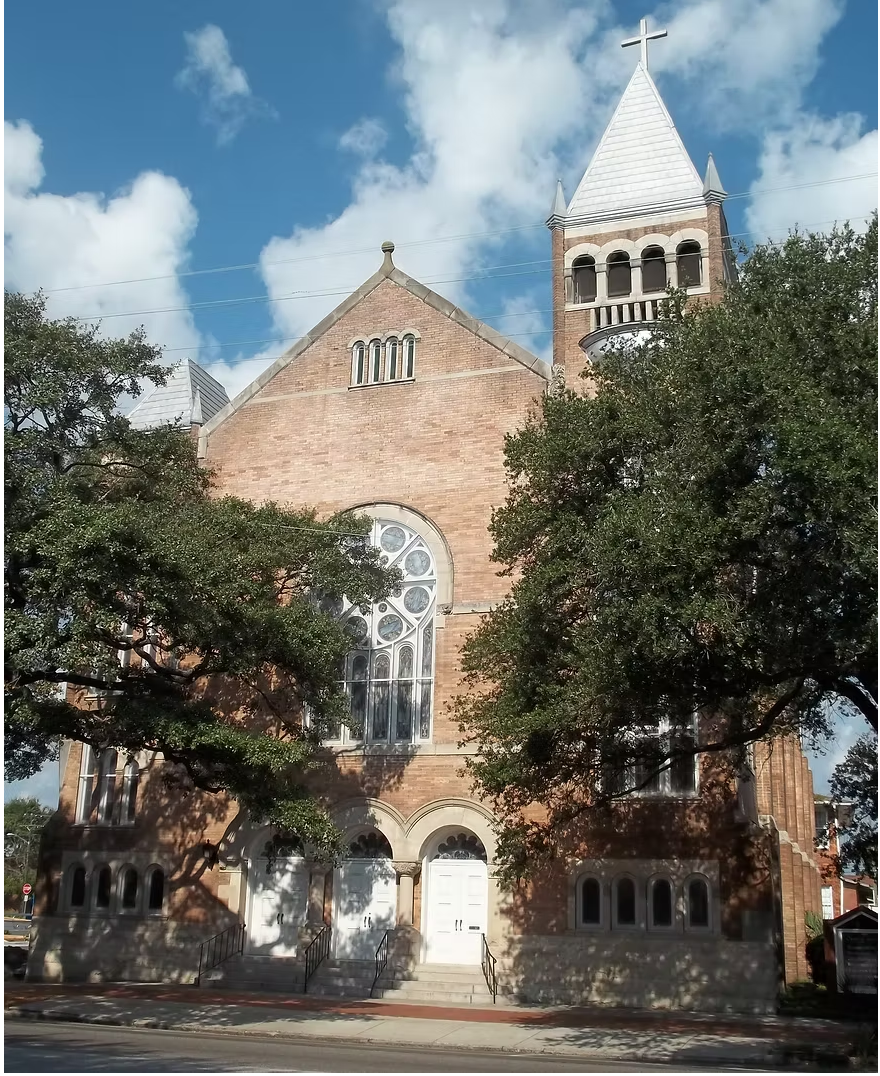
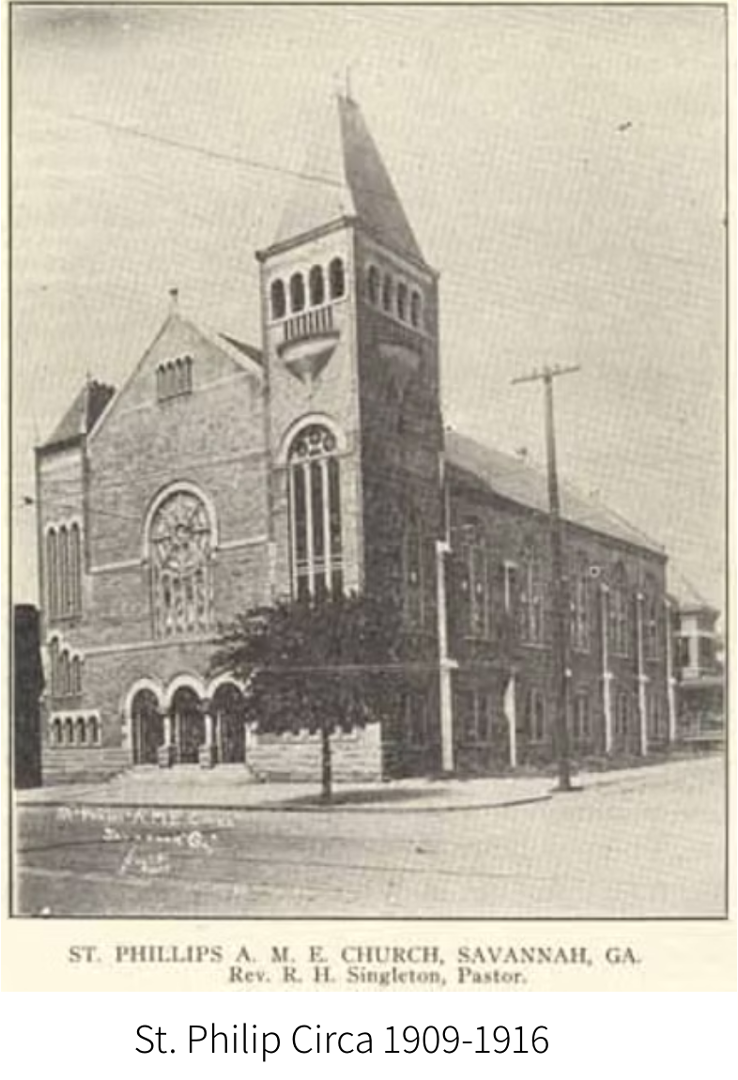
Saint Philip AME Church is one of Savannah’s most important African American religious and civic landmarks. Founded on June 16, 1865, only weeks after the Civil War and emancipation, it became the first African Methodist Episcopal congregation established in Georgia. The congregation emerged from Black Methodists who had worshiped under the supervision of the Methodist Episcopal Church, South. Local leaders William Bentley, C. L. Bradwell, and William Gaines helped preserve the community until AME missionaries arrived. The Rev. A. L. Stanford formally organized the congregation, while the Rev. James Lynch helped connect Savannah’s Black Methodists to the independent AME denomination.
The church’s earliest significance was therefore both spiritual and political: emancipation created the opportunity for Black religious self-governance, and Saint Philip became an institution controlled by African Americans, serving worship, education, leadership development, mutual aid, and community organization. Its Sunday school began shortly after the congregation’s founding, reinforcing the close relationship between Black churches and education during Reconstruction.
The congregation experienced major disruption in 1896, when a severe storm destroyed its church building. Members temporarily worshiped in Odd Fellows Hall before acquiring property at West Broad and Charles Streets. This relocation placed the congregation within Savannah’s historic west-side Black community and helped establish the setting from which the present church would develop.
The building’s architecture should be read as an expression of permanence. Its substantial masonry construction, formal design, and scale communicate that Savannah’s Black citizens intended their religious institutions to be lasting civic anchors. The National Register recognizes Saint Philip under both its contribution to religion and African American community life, and its architectural significance. The property was listed in the National Register of Historic Places on August 2, 1984.
By the mid-twentieth century, St. Philip was more than a worship center. It functioned as a gathering place for Savannah’s Black civic life and became associated with the city’s civil-rights movement. During the 1960s Savannah Protest Movement, Black churches—including St. Philip AME—served as locations for meetings, organizing, communication, and collective decision-making. These religious spaces provided an infrastructure that segregation could not easily eliminate: trusted leadership, regular gatherings, community networks, and a moral language of justice.
___
Sources:
Photo credits: St. Philip AME Church
The interactive version adds a street-following map, narration audio and a guided stop-by-stop experience.